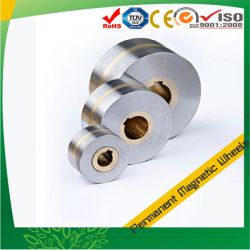
Magnetic wheels Neodymium-iron-boron (NdFeB)
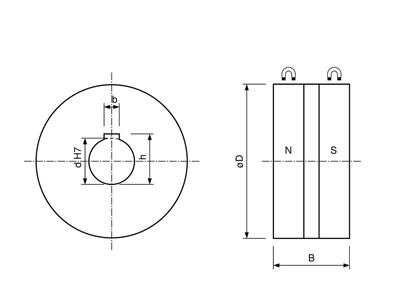
Magnetic wheels with TWO-pole magnetization, NdFeB, bore with fitting tolerance H7 and groove
Article No. D mm d mm B mm b mm H mm Force* N Temperature °C Optimal sheet thickness¹ mm
HSMW-25 25+0.1/-0.1 10 15+0.5/-0.5 3 10.6 25 100 < 0.5
HSMW-32 32+0.1/-0.1 10 15+0.5/-0.5 4 11.1 45 100 < 0.5
HSMW-40 40+0.1/-0.1 12 27+0.5/-0.5 4 13.1 70 100 < 1.0
HSMW-50 50+0.1/-0.1 12 27+0.5/-0.5 4 13.1 90 100 < 1.0
HSMW-63 63+0.15/-0.15 16 39+0.5/-0.5 5 17.3 100 100 < 1.0
HSMW-80 80+0.15/-0.15 20 39+0.5/-0.5 6 21.7 140 100 < 1.5
HSMW-100 100+0.2/-0.2 25 51+0.5/-0.5 8 26.7 290 100 < 1.5
HSMW-125 125+0.2/-0.2 30 63+0.5/-0.5 8 31.7 340 100 < 2.0
HSMW-160 160+0.25/-0.25 40 75+0.5/-0.5 12 42.1 440 100 < 2.0
¹ This value indicates at which sheet thickness the multi-pole magnetic wheel offers greater holding power compared with a two-pole magnetic wheel (for the same diameter D).
Permanent magnetic wheels
Permanent magnetic wheels transport metals from iron to steel automatically, for example with metal decorating presses or before using press- and punching systems
Description
Metals, Tubes, Poles, Profiles etc. are transported safely in Rolling Mills, Drawing Shops, Hardening Shops and galvanic Factories and- even at high speeds- Slip-Free with Magnetic Wheels. The Deployment
of Magnetic Wheels is advantageous when Feeding Metal Sheets and with the Conduction of Scrap Metal in fully or semi automatically working Punching- or Press Systems in Sheet Metal Processing
Operations. Furthermore Magnetic Wheels are often used when Extracting Sheets in Metal Decorating Presses for the Automation of the Process Flow. As Track Rollers for Thermal Cutting Machines,
Magnetic Wheels enable Extractions from steep Iron Walls, even above Head-Height.
Functioning
A magnetic wheel consists of a permanent magnetic system with variable fine pole pitch or two- pole magnetization. Due to the many different close poles of the magnetic wheel, it is ensured that the work
pieces to be extracted are flown through by the magnetic lines even at the smallest wall thickness, without a magnetic saturation or loss of adhesive force. Thus the parts stick safely.
Field of activity
Permanent magnetic wheels lend themselves to use in for example metal processing industry, in fully-or semi automatically working press- and punching systems and in metal decorating presses.
In addition to that they provide a wear-free operation and operational safety without any application of energy.